
Table of Contents
- The Great Creator Burnout: Why Chasing Likes Doesn’t Pay the Bills
- The Shift: From ‘Content Creator’ to ‘System Builder’
- Step 1: Uncover What Your Audience Actually Wants to Buy (The VOC Diamond)
- Step 2: Create a ‘Pillar’ Asset That Solves a High-Value Problem
- Step 3: Repurpose Your Pillar into a Full-Funnel Content System
- Step 4: Automate the ‘Sale’ with a Low-Touch Conversion Funnel
- Key Takeaways
- Frequently Asked Questions
- Conclusion
You’re doing everything ‘right.’ You’re posting on social media, writing blog posts, maybe even recording videos. The content mill is churning. But when you look at your bank account, the numbers don’t reflect the effort. You aren’t just a ‘content creator’—you’re a founder. You’re building a business, not a fan club. This feeling of being constantly busy but getting no tangible return is the fast track to burnout. The good news is, you don’t need more content; you need a better system. It’s time to stop chasing likes and start building a profit engine that runs in the background. Many founders realize their content marketing flow is broken and are stuck on a hamster wheel. This guide will show you how to turn your posts into predictable profit, all without ever needing to pick up the phone for a sales call.
The Great Creator Burnout: Why Chasing Likes Doesn’t Pay the Bills
The term ‘content creation’ itself is part of the problem. It implies an endless cycle of production for the sake of an audience’s fleeting attention. You’re judged by likes, shares, and comments—vanity metrics that feel good but don’t pay for servers, software, or your time. This pressure leads directly to burnout, a feeling overwhelmingly common among creators and founders. A 2021 study revealed that 90% of creators have experienced burnout, and 71% have considered quitting. Why? Because the strategy is flawed from the start.

The Chaos of Unconnected Efforts
For most solo founders, marketing is a collection of fragmented tasks: a LinkedIn post here, a blog article there, an occasional email newsletter. Each piece of content is an island, created to fill a slot in the calendar. There’s no connection, no strategy, and therefore, no momentum. This chaotic approach is exhausting and, worse, ineffective. You’re working in your marketing, not on it. You’re stuck on a content treadmill, constantly feeding a machine that gives you nothing back. The goal isn’t to create more, it’s to create smarter. It’s about building a cohesive system where each piece works together to achieve a single, critical goal: generating revenue. Instead of just making noise, you need to understand how to leverage tools and workflows, a challenge when you’re already confused by AI for content and its actual utility.
Moving Beyond Vanity Metrics
The first step to turning posts into profit is a mindset shift. You must stop valuing ephemeral engagement and start tracking metrics that matter to the business. How many email subscribers did that post generate? How many readers clicked through to your product page? How many started a free trial? These are the numbers that signal true interest and purchase intent. Chasing likes is a game you can’t win as a founder with limited time and resources. Building a system that generates leads and sales is a game you can’t afford to lose.
The Shift: From ‘Content Creator’ to ‘System Builder’
A ‘content creator’ makes posts. A ‘system builder’ creates assets that work for them 24/7. This distinction is the core principle behind turning content into a reliable source of income. A post is disposable; its value peaks within 48 hours and then vanishes into the algorithmic void. A system is a durable, automated engine designed to attract, nurture, and convert customers while you sleep.
As a solo founder, you are the company’s most constrained resource. You cannot afford to spend your time on low-leverage activities. Building a system is the ultimate high-leverage activity. It requires a significant upfront investment of strategic thinking and effort, but once it’s running, it requires minimal daily intervention. This is how you escape the trap of trading your time for dollars (or, in the case of content creation, trading your time for likes). It’s about designing a workflow that transforms cold traffic into happy, paying customers with predictable efficiency. The key is to build an automated funnel that operates on its own, a concept we explore deeply in our 5-step automation playbook for solo founders.
What Does a Content-to-Profit System Look Like?
It’s not as complex as it sounds. A basic system consists of four key stages:
1. Audience Insight: Identifying a high-pain problem your target customer is actively trying to solve.
2. Pillar Asset: Creating one piece of exceptional, long-form content that provides the definitive solution to that problem.
3. Content Distribution & Repurposing: Atomizing the pillar asset into smaller pieces to drive traffic from various channels back to the main resource.
4. Automated Conversion: Using the pillar asset as a lead magnet to capture email addresses and nurture subscribers toward a purchase through an automated sequence.
This is not about ‘creating content.’ It’s about engineering a customer acquisition machine fueled by a single, high-value asset.
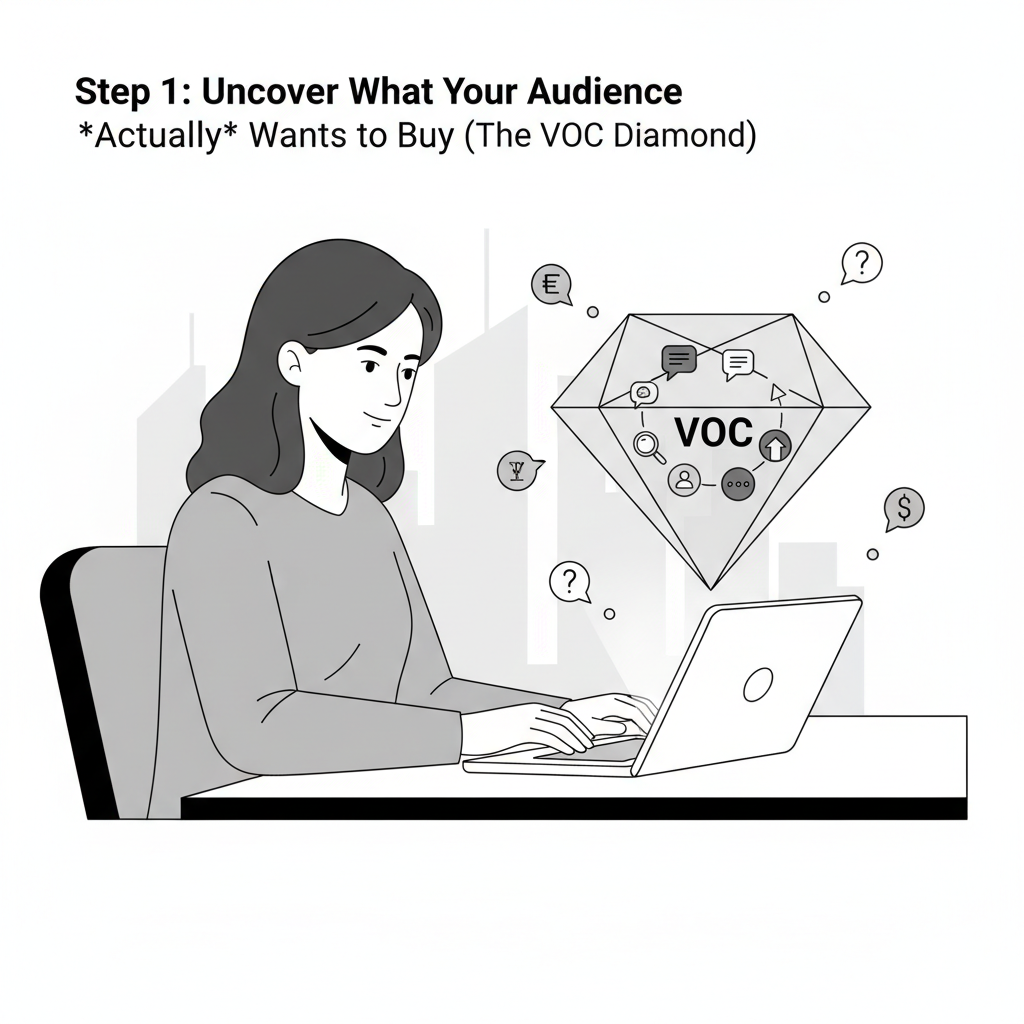
Step 1: Uncover What Your Audience Actually Wants to Buy (The VOC Diamond)
You can’t sell a solution to a problem no one cares about. The most profitable content is born from deep customer understanding, not brainstorming sessions. Before you write a single word, your first job is to become an expert listener. You need to find where your potential customers are expressing their pains, dreams, obstacles, and buying triggers. This is called Voice of Customer (VOC) research.
Instead of guessing, you gather hard evidence from the places where your audience congregates online:
Reddit & Niche Forums: Look for threads where people ask for help, complain about their current tools, or describe their workflows.
Software Review Sites (G2, Capterra): Read reviews for competing or adjacent products. The ‘Cons’ section is a goldmine of unmet needs.
Social Media: Use search filters to find keywords related to the problem you solve. What questions are people asking? What frustrations are they venting?
Your Own Customer Interactions: Every support ticket, sales inquiry, and onboarding call contains valuable insights.
Structuring Insights with the VOC Diamond
At SoloFounderMarketing, we structure this raw data into what we call a VOC Diamond: Pains, Dreams, Obstacles, and Buying Triggers. This framework helps you move from random notes to strategic insights. For example, a founder building a project management tool might find:
Pain: ‘I’m constantly switching between 5 different apps to manage my projects; it’s chaotic.’
Dream: ‘I just want one place where I can see everything and know what my team is working on without asking.’
Obstacle: ‘New tools are so hard to learn, and I don’t have time to migrate everything.’
Buying Trigger: ‘My free trial for Asana is ending, and I can’t justify the cost for my small team.’
This level of insight is the foundation of a profit-generating content system. A blog post titled ‘5 Tips for Better Project Management’ is forgettable. An article titled ‘The All-in-One Project Dashboard: How to Ditch 5 Apps and Reclaim Your Sanity’ directly addresses the pain and dream, creating an instant connection. This insight-driven approach ensures your content isn’t just noise; it’s a magnet for potential customers, a principle illustrated in our guide to making sales with AI, not just noise.
Step 2: Create a ‘Pillar’ Asset That Solves a High-Value Problem
Once you’ve identified a deep, pressing problem from your VOC research, it’s time to create the centerpiece of your profit engine: the pillar asset. This is not just another blog post. It is a comprehensive, definitive guide that provides so much value, your audience would consider paying for it. This is your chance to demonstrate true expertise and build authority.
According to research from HubSpot, companies that blog get 97% more links to their websites, but a pillar asset supercharges this effect. It’s a resource people bookmark, share with their teams, and reference for months or even years. It becomes a cornerstone of your online presence and a powerful lead-generation tool. The goal is to create the best resource on the internet for that specific problem.
Characteristics of a Powerful Pillar Asset:
Actionable and Specific: It should provide a step-by-step framework, a detailed guide, or a complete system that readers can implement immediately. Avoid vague advice.
In-Depth and Comprehensive: Aim for a high word count (2,500 words is a good starting point) and cover the topic from every relevant angle. Answer every question a reader might have.
Data-Rich and Credible: Include statistics, real-world examples, and case studies to back up your claims. This builds trust and authoritativeness.
Visually Engaging: Use images, diagrams, tables, and formatting to make the content easy to digest. A wall of text, no matter how valuable, will be ignored.
This isn’t about churning out content; it’s a strategic investment. We’ve seen firsthand how a single, powerful piece of content can become the foundation for immense growth, as detailed in our case study on a SaaS founder generating $10K/month from content. That founder didn’t write 100 articles; they wrote a handful of exceptional ones that did all the heavy lifting.
Step 3: Repurpose Your Pillar into a Full-Funnel Content System
Your pillar asset is a goldmine of content. The work isn’t done when you hit ‘publish’; it has just begun. The next step is to ‘atomize’ this long-form piece into dozens of smaller content nuggets for distribution across different channels. This is how you maximize the ROI on your initial time investment and drive targeted traffic back to your core asset.
This ‘create once, distribute forever’ model is the secret to getting off the content treadmill. Instead of constantly wondering what to post next, you have a ready-made source of high-value content. Each repurposed piece acts as a signpost, pointing traffic from social media, email, and other platforms back to your pillar post, where you can convert that traffic into leads.
The Art of Content Atomization:
Let’s say your pillar asset is a 3,000-word guide on ‘How to Automate Client Onboarding.’ You can easily repurpose it into:
10-15 Social Media Posts: Each key takeaway, statistic, or quote from the guide becomes a separate post for LinkedIn or Twitter.
A 5-Part Email Mini-Course: Break down the main sections of the guide into a short, educational email series.
A Twitter Thread: Summarize the main steps of your framework into a viral-potential thread.
A Visually Appealing Infographic: Turn the key data points and steps into a shareable graphic for Pinterest and LinkedIn.
A YouTube Video Script: Use the pillar post as a detailed script for a tutorial video.
A Guest Post Outline: Adapt a unique angle from your pillar post and pitch it to another blog in your niche for backlinks and referral traffic.
This strategy allows a single founder to create a multi-channel content presence that feels like it’s run by a full team. It’s the ultimate workflow for efficiency, ensuring every piece of content serves the strategic goal of driving traffic and leads. To get even more mileage, you can think beyond blog posts and repurpose this one asset to fuel your entire sales funnel in creative ways.
Step 4: Automate the ‘Sale’ with a Low-Touch Conversion Funnel
This is where your system truly becomes profitable and passive. All the traffic you’re driving to your pillar asset is wasted unless you have a mechanism to convert visitors into customers. This is done ‘without a single sales call’ by building a simple, automated email funnel. The goal is to get the reader to exchange their email address for more value, then nurture that relationship on autopilot.
First, you need to ‘gate’ a portion of your pillar asset or offer a ‘content upgrade.’ This is a bonus resource that’s so valuable, people are happy to provide their email to get it. Examples include:
A downloadable checklist or worksheet.
A free email course.
A template or spreadsheet.
A video tutorial that expands on the article.
Once you have their email, the automated sequence begins. This is not a salesy, high-pressure campaign. It’s a continuation of the value you provided in the pillar post. A simple but effective nurturing sequence could look like this:
Email 1 (Immediate): Delivers the content upgrade and re-introduces the core problem.
Email 2 (Day 2): Provides another valuable tip or a short case study related to the problem.
Email 3 (Day 4): Addresses a common objection or mistake people make when trying to solve the problem themselves.
Email 4 (Day 6): Introduces your product as the logical next step—the ‘easy button’ to implement the solution they’ve been learning about. This email includes a clear call-to-action to check out the product, start a trial, or book a demo.
* Email 5 (Day 7): A final follow-up with social proof (testimonials, reviews) and a sense of urgency (e.g., ‘Stop struggling with X and see results today’).
This automated system works 24/7 to build trust, demonstrate your expertise, and present your offer to warm, educated leads. It’s the engine that turns content views into revenue, a core component of the 5-step automation playbook that successful founders use to scale.
| Approach | The ‘Content Creator’ | The ‘System Builder’ |
|---|---|---|
| Primary Goal | Likes, Shares, Audience Growth | Leads, Sales, Revenue |
| Key Asset | Daily/Weekly Posts | Pillar Content & Automated Funnel |
| Effort Model | Constant, High-Effort Production | Upfront Investment, Low-Effort Maintenance |
| Scalability | Low (Tied to Your Time) | High (Automated System Works 24/7) |
| ROI | Unpredictable, often low | Predictable and compounding over time |
Industry insight: Businesses that prioritize blogging are 13x more likely to see positive ROI.
Industry insight: Nurtured leads make 47% larger purchases than non-nurtured leads, proving the value of automated email funnels.
Key Takeaways
| Component | Purpose | Example Tools |
|---|---|---|
| Pillar Content | Attracts targeted traffic by solving a major problem. | In-depth blog post, ultimate guide, webinar. |
| Content Upgrade/Lead Magnet | Captures email addresses in exchange for high-value bonus content. | Checklist, template, email course, eBook. |
| Landing Page | A dedicated page to ‘sell’ the lead magnet and collect emails. | Carrd, Leadpages, Unbounce, Webflow. |
| Email Autoresponder | Automatically nurtures subscribers with a pre-written email sequence. | ConvertKit, MailerLite, ActiveCampaign. |
| Tripwire/Intro Offer | A low-cost, high-value initial offer to convert subscribers into customers. | A mini-course for $27, a paid tool for $7, a detailed report. |
Frequently Asked Questions
How much traffic do I need to make money from my content?
There’s no magic number. Profitability depends more on the quality of your traffic and the effectiveness of your conversion funnel than on raw volume. A blog with 1,000 highly-targeted monthly visitors who have a pressing problem can be far more profitable than a site with 100,000 casual readers. Instead of focusing on traffic volume, focus on attracting the right visitors by creating content that solves a specific, high-value problem. Then, optimize your automated funnel to convert those visitors into customers. A 2% conversion rate on 1,000 targeted visitors is better than a 0.01% rate on 100,000.
How long does it take to see profit from a content system?
Building a content-to-profit system is a long-term investment, not a get-rich-quick scheme. It typically takes 3-6 months to see meaningful results. The initial phase involves research, creating your pillar asset, and setting up the automation. It takes time for content to rank in search engines and for traffic to build. However, once the system is running, it generates leads and sales with increasing momentum and minimal ongoing effort. The key is consistency and patience. Unlike paid ads, which stop when you stop paying, this system is an asset that appreciates over time.
What are the best tools for automating a content funnel?
You don’t need a complex or expensive tech stack. As a solo founder, simplicity is key. Start with three core components: 1) A landing page builder to host your pillar asset and capture leads (e.g., Carrd, Webflow). 2) An email marketing service with automation capabilities (e.g., ConvertKit, MailerLite). 3) Your website or blog platform (e.g., WordPress, Ghost). Many founders get stuck trying to stitch together too many fragmented and overwhelming manual marketing efforts. The SoloFounderMarketing Toolkit can help streamline these processes by integrating research, content generation, and distribution workflows into one platform.
Can this system work for any niche or industry?
Absolutely. This framework is industry-agnostic because it’s based on a fundamental principle of business: solving customer problems. Whether you sell a B2B SaaS product, a DTC physical good, an info product, or a high-ticket service, the process is the same. You must first identify a painful problem your audience has, create a definitive resource that helps them solve it, and then use that resource to build trust and guide them toward your paid solution. The tactics might change slightly (e.g., the channels you use for distribution), but the core strategy of building a value-driven, automated system remains universal.
What’s the biggest mistake founders make with content?
The biggest mistake is treating content as a promotional tool instead of a product in itself. They write self-serving articles about their features and company news, which nobody wants to read. Profitable content focuses entirely on the reader’s problems and aspirations. Your product should only be mentioned at the end of the journey, positioned as the logical next step after you’ve provided immense value and built trust. Remember, people don’t care about your product; they care about their problems. Solve their problems with your content, and you’ll earn the right to introduce your product as the ultimate solution.
Is this better than running paid ads?
It’s not about better or worse; it’s about building a different kind of asset. Paid ads are like renting a home—the traffic stops the moment you stop paying. Building a content system is like buying a home—it requires an upfront investment, but you build a valuable, long-term asset that generates returns (organic traffic, authority, leads) for years to come. For solo founders with constrained budgets, a content-to-profit system is often more sustainable and can deliver a much higher long-term ROI. The best strategy often involves using content as the foundation and later amplifying it with paid ads once you have a proven, converting funnel.
Conclusion
The cycle of creating content that goes nowhere is exhausting and unsustainable. The solution isn’t to work harder or post more often; it’s to transform your approach from that of a ‘content creator’ to a ‘system builder.’ By focusing on deep customer insights, creating a single high-value pillar asset, repurposing it strategically, and automating the conversion process, you can build a reliable profit engine that works for you. This system frees you from the content treadmill and allows you to focus on what you do best: building a great product. Stop chasing likes and start building an asset that pays. By focusing on a systematic approach, you can create a real engine for growth, like the founder who generated $10K/month from strategic content.
Want proven systems to grow as a solo founder?
Learn more at SoloFounderMarketing.com — no fluff, no ads.