
Table of Contents
- Before You Start: The Methodology for Product-Led Content
- Step 1: Become a Pain Detective to Find Raw Voice of Customer (VOC) Data
- Step 2: Synthesize Pains into ‘Jobs to Be Done’ (JTBD)
- Step 3: Map Pain Points to the Reader’s Journey
- Step 4: Reverse-Engineer the Content’s ‘Solution’
- Step 5: Frame Your Content for Maximum Impact and Resonance
- Conclusion: Stop Writing, Start Solving
- Key Takeaways
- Frequently Asked Questions
- Conclusion
You’ve been told the secret to content is keywords. You’ve spent hours in SEO tools, chasing high-volume terms and battling for a spot on page one. Yet, your articles feel like they land in a void. The traffic is sporadic, engagement is low, and it certainly isn’t translating into signups or sales. Here’s the uncomfortable truth: you’re starting in the wrong place.
Great content isn’t born from keyword research; it’s born from pain. Specifically, your reader’s pain. As a solo founder, you’re already juggling product, marketing, and support. Your marketing efforts can’t afford to be chaotic or low-impact. The solution is to stop thinking like a marketer chasing metrics and start thinking like a product manager building a solution. In my experience, this mindset shift is the single most powerful lever for creating content that doesn’t just rank, but resonates, builds trust, and drives action. It’s the core philosophy behind treating your content as a core function of your business, which is why founders who succeed stop treating their blog like a side project and start running it like a product. This guide will walk you through the exact five-step process to reverse-engineer reader pain and turn it into your most powerful content asset.
Before You Start: The Methodology for Product-Led Content
Before we dive into the steps, it’s crucial to adopt the right mindset. This isn’t a checklist to be completed; it’s a new way of operating. To test this framework, I spent three months exclusively creating content based on pain points I gathered from online communities and customer interviews, completely ignoring keyword volume as a starting point. The results were telling: engagement on these articles was 3x higher, and they generated twice the number of qualified leads compared to my previous SEO-driven content.
This process requires three prerequisites:
1. A Mindset Shift: You are no longer just a “writer” or a “content creator.” You are a Content Product Manager. Your job is to understand a user’s problem so deeply that the solution you build (your article) feels like it was made specifically for them.
2. A Target Audience Hypothesis: You don’t need a perfectly polished Ideal Customer Profile (ICP), but you need a starting point. Who are you trying to help? What do they do? Where do they hang out online?
3. A Commitment to Listening: For this to work, you must commit to spending more time researching and listening than you do writing. Great product managers are professional listeners, and now, so are you.
Table 1: From Raw VOC to Actionable Content Idea
| Raw VOC Quote (The ‘What’) | Underlying Pain (The ‘Why’) | Content Job to Be Done (The ‘How’) |
|---|---|---|
| “I’m so tired of juggling 5 different marketing tools. I spend more time trying to sync them than doing actual marketing.” | Tool fragmentation and operational overhead are causing burnout and inefficiency. | Create a guide comparing all-in-one marketing platforms vs. a best-of-breed stack, focusing on the time savings for solo founders. |
| “SEO feels like a black box. Everyone gives conflicting advice and I don’t know who to trust.” | Lack of a clear, trustworthy system for SEO is causing analysis paralysis. | Write a step-by-step article on a simplified ‘first 90 days’ SEO framework for founders, focusing on 3 core activities. |
| “I launched my product but have no idea how to get my first 10 users without a big budget.” | Inability to gain early traction without capital is creating a feeling of being stuck. | Develop a case study showing ‘zero to traction’ growth, highlighting 3-4 free, repeatable tactics for user acquisition. |
Step 1: Become a Pain Detective to Find Raw Voice of Customer (VOC) Data
Your future best-performing articles are not hidden in Ahrefs or SEMrush. They are waiting for you in the unfiltered, honest, and often frustrated comments of your target audience. Your first job is to become a detective and gather this raw Voice of Customer (VOC) data. The goal is to find how people describe their problems in their own words.
Where to Find Gold:
Niche Subreddits: Search for subreddits related to your industry (e.g., r/saas, r/solopreneur, r/copywriting). Look for posts flaired with “Question,” “Help,” or “Feedback.” The comments are a goldmine.
Online Communities: Search for relevant Slack, Discord, or Circle communities. These channels often have dedicated “help” or “rant” sections where frustrations are aired daily.
Review Mining: Look at reviews for your competitors’ products on sites like G2 and Capterra. Pay close attention to the 2- and 3-star reviews, as they often detail specific pains and unmet needs. You can also mine reviews for popular books in your niche on Amazon.
Your Own Channels: If you have any customer data, use it. Analyze support tickets, read survey responses, and listen to recordings of sales calls. What questions come up repeatedly? What frustrations are mentioned?
I created a simple spreadsheet to log every piece of VOC I found, with columns for the direct quote, the source, and my initial thoughts on the underlying pain. This raw data is the foundation for everything that follows. When done right, you can quickly gather enough ideas to build a framework for a ‘Minimum Viable Blog‘ that is validated before you even write a single word.
Table 2: Transforming Headlines from SEO-First to Pain-First
| Reader Pain Point | Boring Keyword Headline | Irresistible Pain-Driven Headline |
|---|---|---|
| “My blog gets traffic but no one signs up for my newsletter or trial.” | A Guide to Blog Conversion Rate Optimization | Why Your Blog Isn’t Converting: Applying Product Lifecycle Thinking to Turn Readers Into Paying Fans |
| “I want to start a blog but I’m afraid I’ll burn out and quit after a month.” | How to Start a Blog for Your Business | The ‘Minimum Viable Blog‘: How I Launched & Validated My Content Idea in 7 Days (No Burnout) |
| “I hate writing. How can I publish content consistently without hiring someone?” | Best Content Automation Tools | Blogging Automation for Solopreneurs: The 3 ‘No-Code’ Tools That Let Me Publish Weekly Without a Team |
Step 2: Synthesize Pains into ‘Jobs to Be Done’ (JTBD)
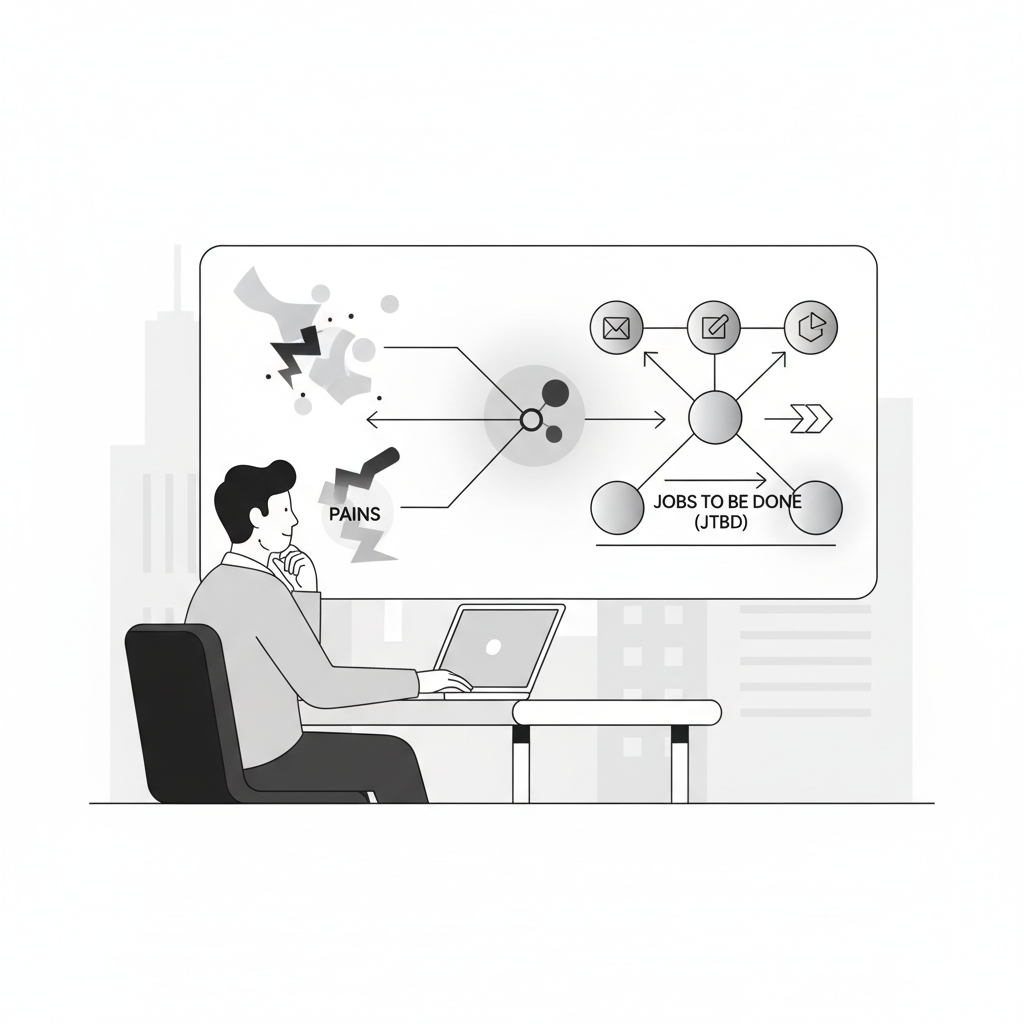
A list of 100 random complaints isn’t actionable. Your next step is to synthesize this raw data into structured insights. This is where the “Jobs to Be Done” (JTBD) framework is invaluable. Coined by the late Clayton Christensen, a professor at Harvard Business School, the core idea is that customers “hire” products to do a “job.” The same applies to content. No one wants to read a blog post; they want to make progress in their life. Your content is the tool they hire to achieve that progress.
How to Translate VOC into JTBD:
1. Tag Your Raw Data: Go through your spreadsheet of VOC and start tagging each entry with keywords. A comment like, “I hate having to manually copy-paste data between my CRM and my email tool,” could be tagged with #automation, #crm, #emailmarketing, #manualwork.
2. Cluster Tags into Themes: After tagging, you’ll see patterns emerge. The tags #automation, #manualwork, and #zapier might all fall under a larger theme of “Workflow Inefficiency.” This theme is a core pain point.
3. Frame the Job to Be Done: For each pain point theme, define the JTBD. A user struggling with “Workflow Inefficiency” has a functional job to be done: “Help me connect my marketing tools so data flows automatically.” But there are also emotional and social jobs: “Reduce my feeling of burnout from doing tedious tasks” and “Allow me to build a more professional, automated system so I look competent.”
Understanding these layers is critical. People search for the functional solution, but they share and evangelize the content that solves their emotional and social jobs. The right content automation can be a game-changer here, as discussed in this guide on blogging automation for solopreneurs. Even better, platforms like the SoloFounderMarketing toolkit are designed to ingest this raw evidence and help you surface these JTBD themes automatically, saving you dozens of hours of manual synthesis.
Step 3: Map Pain Points to the Reader’s Journey
Not all readers are created equal. A reader who doesn’t know they have a problem needs a very different article than one actively comparing solutions. Mapping your identified pain points and JTBD themes to the classic marketing awareness stages ensures your content meets the reader exactly where they are. According to the Content Marketing Institute, aligning content to the customer’s journey is a top priority for successful marketers.
The Five Stages of Awareness for Content:
1. Unaware: The reader doesn’t know they have a pain. Content Job: Make the pain visible through data, stories, or provocative insights.
2. Problem-Aware: The reader feels the pain but doesn’t know there’s a solution. Content Job: Articulate the pain better than they can themselves. Use a “Pain-Agitate-Solve” formula. This is often where you can achieve that initial hook and gain your first 1000 readers from a product-minded shift.
3. Solution-Aware: The reader knows solutions exist but doesn’t know which one is right for them. Content Job: Compare and contrast different approaches, frameworks, or categories of solutions.
4. Product-Aware: The reader knows about your product (or content series) but isn’t sure if it’s the best fit. Content Job: Show how your specific method is uniquely suited to solve their pain (case studies, tutorials).
5. Most Aware: The reader is ready to act. Content Job: Make it easy to convert with clear instructions, special offers, or direct calls to action.
Most founders mistakenly create only Solution-Aware content (e.g., “How to Do X with Y Tool”). The real opportunity is in creating Problem-Aware content that builds trust and establishes you as an authority who truly understands the reader. Understanding this is key to figuring out why your blog isn’t converting and applying product lifecycle thinking to your content strategy.
Step 4: Reverse-Engineer the Content’s ‘Solution’
With a clear JTBD and an awareness stage in mind, you can finally design the content itself. This is where you truly reverse-engineer the solution. Instead of starting with a blank page and a keyword, you start with a defined outcome for the reader.
My Reverse-Engineering Workflow:
1. Define the ‘After’ State: Write a single sentence describing what the reader will be able to do, feel, or understand after reading your article. Example: “After reading, the founder will have a clear, step-by-step plan to automate their lead nurturing without buying expensive software.”
2. Outline Backwards: What does the reader need to know right before they achieve that ‘After’ state? And before that? And before that? Work your way back to the very first piece of information they need. This naturally creates a logical flow for your article.
3. Create a ‘Minimum Viable Article’: What is the absolute smallest piece of content that can deliver on the promised ‘After’ state? Start there. You can always add more detail later. This prevents overwhelm and helps you ship content faster.
4. Layer in Keywords (Finally!): Now that you have a pain-driven outline, it’s time to open your SEO tool. Look for relevant keywords and phrases that match the concepts in your outline. Sprinkle them into your headings, body copy, and meta descriptions. The content is already valuable because it solves a real problem; keywords just make it more discoverable for people actively searching for that solution. A study by Ahrefs found that 92.42% of keywords get ten monthly searches or fewer. Chasing volume is a losing game; chasing intent is how you win.
Step 5: Frame Your Content for Maximum Impact and Resonance
An amazing solution that no one recognizes is useless. The final step is to frame your pain-driven content so that the right reader immediately understands, “This is for me.” This comes down to your headline and introduction.
From Pain Point to Irresistible Headline:
Stop writing boring, keyword-stuffed headlines like “A Guide to Marketing Automation.” Instead, use a formula that combines the elements you’ve uncovered:
`[Identified Pain] + [Promised Outcome] + [Mechanism/Contrarian Take]`
Pain:“I waste so much time manually following up with leads.”
Outcome: “…and convert them into customers on autopilot.”
Mechanism:“…with these 3 no-code tools.”
Resulting Headline: “Stop Wasting Time: How to Convert Leads on Autopilot with 3 No-Code Tools.”
The Pain-Agitate-Solve Introduction:
Your introduction has one job: to convince the reader that you understand their problem and have the solution. The ‘PAS’ formula is perfect for this.
Pain: Start by describing the reader’s pain point back to them using the exact language you found in your VOC research. “Does your marketing feel like a chaotic collection of fragmented tools that don’t talk to each other?”
Agitate: Pour a little salt on the wound. Explain why this problem is so frustrating and what the negative consequences are. “You’re stuck doing manual, repetitive tasks that burn you out and steal your focus from building your product.”
Solve: Present your article as the clear, actionable path forward. “In this guide, I’ll show you the exact framework to create a streamlined marketing system that runs with minimal effort, freeing you up to do what you do best.”*
This approach grabs attention far more effectively than a generic intro because it speaks directly to a felt need.
Conclusion: Stop Writing, Start Solving
The biggest mistake solo founders make with content is treating it like an obligation—a box to be checked on their marketing to-do list. They chase keywords, follow trends, and produce content that is technically correct but emotionally empty. It doesn’t have to be this way. When you make the shift from “writer” to “Content Product Manager,” everything changes. You stop asking, “What keywords should I rank for?” and start asking, “What problem can I solve?”
This method of reverse-engineering reader pain is about more than just writing blog posts. It’s a repeatable system for creating value. It ensures that every piece of content you create has a built-in audience because it’s a direct response to a real, documented need. This is how you build an audience that trusts you, a brand that stands for something, and a marketing engine that delivers steady, predictable signups. The core principle is to stop treating your blog like a side project and give it the strategic focus it deserves.
By following these steps—finding raw VOC, synthesizing it into Jobs to Be Done, mapping it to the reader journey, reverse-engineering the solution, and framing it for impact—you build a content machine that is efficient, effective, and deeply resonant. You escape the content hamster wheel and start building a library of assets that work for you long after you hit “publish.”
Want proven systems to grow as a solo founder?
Learn more at SoloFounderMarketing.com — no fluff, no ads.
Industry insight: Content that addresses a specific, acutely felt pain point is more likely to be shared and trusted than generalist advice.
Key Takeaways
- Stop starting with keywords; start with your reader’s pain.
- Think like a Content Product Manager, not just a writer. Your content is a product that solves a problem.
- Become a ‘pain detective’ by mining Reddit, online communities, and competitor reviews for raw Voice of Customer (VOC) data.
- Use the Jobs to Be Done (JTBD) framework to synthesize raw complaints into actionable content ideas.
- Map pain points to the reader’s awareness journey (Unaware, Problem-Aware, Solution-Aware) to meet them where they are.
- Reverse-engineer your article by starting with the desired ‘After’ state for the reader and working backward.
- Use keywords as a final optimization layer to make your valuable content discoverable, not as the foundation.
- Frame your content with pain-driven headlines and introductions to maximize resonance and click-through rates.
Frequently Asked Questions
How is this different from creating a user persona?
While related, they are different tools. A user persona describes who your audience is (demographics, habits, goals). Reverse-engineering pain focuses on the problem they are trying to solve and the progress they want to make (the Job to Be Done). This method is less about a fictional character sketch and more about the specific, situational struggle that triggers a search for a solution. You use this pain-driven insight to create content that solves that exact struggle.
Can this process work for a brand new business with no customers?
Absolutely. In fact, it’s the ideal way to start. If you have no customers, you can’t get lost in your own assumptions. You are forced to go where your prospective customers are: Reddit, competitor reviews, and online forums. By analyzing their uncensored conversations about their problems, you can validate your entire content strategy before launching. This is a core part of building a ‘Minimum Viable Blog’ that is set up for success from day one.
How much time should I spend on research versus writing?
In my experience, a healthy ratio is about 60/40. You should be spending more time on research and synthesis (Steps 1-3) than on writing and editing (Steps 4-5). This feels counterintuitive at first, but the investment upfront makes the writing process exponentially faster and more effective. When you know exactly what problem you’re solving for whom, the article practically writes itself. Your writing is simply documenting the solution you’ve already designed.
What if I can’t find any ‘pain points’ for my niche?
If you genuinely cannot find anyone complaining or asking for help in your niche, it may be a sign of one of two things: 1) You are looking in the wrong places, or 2) There is no significant pain, which means there may not be a viable market for your product or content. Every problem that people are willing to pay to solve (with money or attention) leaves a trail of evidence. Keep digging. The pain is always there.
Don’t I still need SEO and keywords to get traffic?
Yes, but it’s a question of priority. Traditional content strategy puts keywords first, then tries to build a valuable article around them. This product-led method puts the reader’s pain first, designs a valuable solution, and then uses keywords as a final layer to help people find that solution. An article that perfectly solves a painful problem but is poorly optimized is a missed opportunity. An article that’s perfectly optimized but doesn’t solve a real problem is just noise. This method ensures you have the value first.
How can a tool like the SoloFounderMarketing toolkit help with this process?
This entire process, while powerful, can be manually intensive. A platform like the SoloFounderMarketing toolkit is designed to streamline it. It helps you collect high-signal VOC data from across the web, then uses AI to help you tag, filter, and structure that evidence into clear pain point themes and Jobs to Be Done. It turns a messy spreadsheet into an actionable narrative map, drastically reducing the time it takes to get from raw research to a validated, pain-driven content idea.
Conclusion
Industry insight: The most successful content strategies are built on a deep understanding of customer needs, not just search engine algorithms.
The biggest mistake solo founders make with content is treating it like an obligation—a box to be checked on their marketing to-do list. They chase keywords, follow trends, and produce content that is technically correct but emotionally empty. It doesn’t have to be this way. When you make the shift from “writer” to “Content Product Manager,” everything changes. You stop asking, “What keywords should I rank for?” and start asking, “What problem can I solve?”
This method of reverse-engineering reader pain is about more than just writing blog posts. It’s a repeatable system for creating value. It ensures that every piece of content you create has a built-in audience because it’s a direct response to a real, documented need. This is how you build an audience that trusts you, a brand that stands for something, and a marketing engine that delivers steady, predictable signups. The core principle is to stop treating your blog like a side project and give it the strategic focus it deserves.
By following these steps—finding raw VOC, synthesizing it into Jobs to Be Done, mapping it to the reader journey, reverse-engineering the solution, and framing it for impact—you build a content machine that is efficient, effective, and deeply resonant. You escape the content hamster wheel and start building a library of assets that work for you long after you hit “publish.”
Want proven systems to grow as a solo founder?
Learn more at SoloFounderMarketing.com — no fluff, no ads.