
Table of Contents
- Before You Start: The Critical Prerequisite Mindset Shift
- Step 1: Define Your ‘Sufficient’ Input Metric (My Anti-Burnout Goal)
- Step 2: Build a Detached Publishing Machine (Your Content Assembly Line)
- Step 3: Implement a System of Record (Your Single Source of Truth)
- Step 4: Schedule Public Accountability (Even to an Empty Room)
- Step 5: Conduct Scheduled, Detached Performance Reviews
- Common Mistakes to Avoid With This Framework
- You’ll Know You’ve Succeeded When…
- Key Takeaways
- Frequently Asked Questions
- Conclusion
Feeling invisible is the default state for most founders. You pour your soul into creating content, you hit “publish,” and… nothing. No likes, no comments, no sales. Just the deafening silence of the digital void. I know this feeling intimately. In my early days, I would refresh my analytics page a dozen times a day, my mood swinging with every empty dashboard. I was convinced I was shouting into a hurricane. Most founders quit at this stage. They mistake the silence for failure. But what I discovered is that consistency isn’t born from motivation or early wins; it’s forged in a system that makes feedback irrelevant. This is the framework I built to not just survive the silence, but to use it as a runway for growth. It’s about treating your marketing like an engineering problem, not an emotional rollercoaster. Before you can build momentum, you have to understand why most people Stop Wasting Time: Build Momentum When Nobody’s Watching (and Why Most Founders Quit Too Soon). This guide is the practical “how-to” for doing just that.
Before You Start: The Critical Prerequisite Mindset Shift
Before we even touch a single step of the framework, we have to address the real problem: your mindset. You are currently wired to seek external validation. A like, a share, or a sale triggers a dopamine hit, reinforcing your behavior. When that reward disappears, so does your motivation. This is a fatal flaw in any long-term strategy. The path to consistency begins with a conscious decision to detach your effort from the outcome.
My methodology for developing this framework was born from six months of posting to near-total silence. I had to learn to operate without any positive reinforcement. I shifted my identity from

Comparison: Input-Focused vs. Output-Focused Goals
| Factor | Input-Focused Goal (The Framework) | Output-Focused Goal (The Default) |
|---|---|---|
| Control | 100% Controllable | Largely Uncontrollable |
| Psychological Effect | Builds agency and intrinsic motivation | Creates anxiety and dependence on external factors |
| Focus | Process & Effort | Results & Luck |
| Example | ‘Publish 2 articles per month’ | ‘Get 1,000 unique visitors per month’ |
| Failure Mode | Burnout (if metric is too high) | Despair and quitting too early |
Step 1: Define Your ‘Sufficient’ Input Metric (My Anti-Burnout Goal)
Your first action is to trade unpredictable output goals for controllable input goals. An output goal is ‘get 100 subscribers’ or ‘make $1,000 in sales.’ These are not fully in your control and lead to despair when you miss them. An input goal is ‘publish two articles per month’ or ‘record one podcast episode per week.’ You have 100% control over this.
In my experience, the key is defining a ‘sufficient’ metric. Don’t aim for the maximum possible; choose the minimum effective dose that you can sustain even on your worst week. For me, that was ‘publish one in-depth blog post every two weeks.’ It was a target I knew I could hit no matter how busy I got with product development. This prevents the cycle of over-commitment followed by burnout. According to a study published in the British Journal of Health Psychology, it takes an average of 66 days to form a new habit, and consistency is more important than intensity in the early stages. This focus on process over ambitious goals is crucial. You want to avoid the trap of thinking all your work has to be a masterpiece; you need to separate your work into smart habits, not just hard ones.
How I Chose My Input Metric
I started by tracking my time. I realized that a deeply researched article took me about 8-10 hours total. Trying to do one per week while also coding was a recipe for disaster. But one every two weeks? That was just over 30 minutes of focused effort per day. It felt manageable and, more importantly, repeatable. This is the sweet spot. Your metric should feel almost too easy at first. That’s how you build the initial momentum without willpower.
Why ‘Sufficient’ is the Magic Word
The goal here isn’t to become a content machine overnight. It’s to build a foundation of trust with yourself. Every time you hit your sufficient input goal, you prove to yourself that you are a person who follows through. This builds intrinsic motivation, which is far more powerful and resilient than the fleeting motivation that comes from external praise. This input-based approach turns marketing from a gamble into a predictable operation.
Common Consistency Killers & System-Based Solutions
| The Problem (The Feeling) | The Solution (The System) |
|---|---|
| Feeling Uninspired | Don’t wait for inspiration. Execute the next step in your ‘Publishing Machine’ (e.g., ‘Do research for 30 mins’). |
| Not Seeing Results | Ignore results. Open your ‘System of Record’ and celebrate hitting your input goal for the week. |
| Feeling Overwhelmed | Your input goal is too high. Reduce it to a ‘sufficient’ level until it feels manageable. Batch smaller tasks together. |
| Procrastination | Use public accountability. Announce your next publish date to create a ‘Ulysses Pact’ you can’t easily break. |
| Perfectionism | The goal is ‘published,’ not ‘perfect.’ Trust the system and ship the content. The assembly line must keep moving. |
Step 2: Build a Detached Publishing Machine (Your Content Assembly Line)
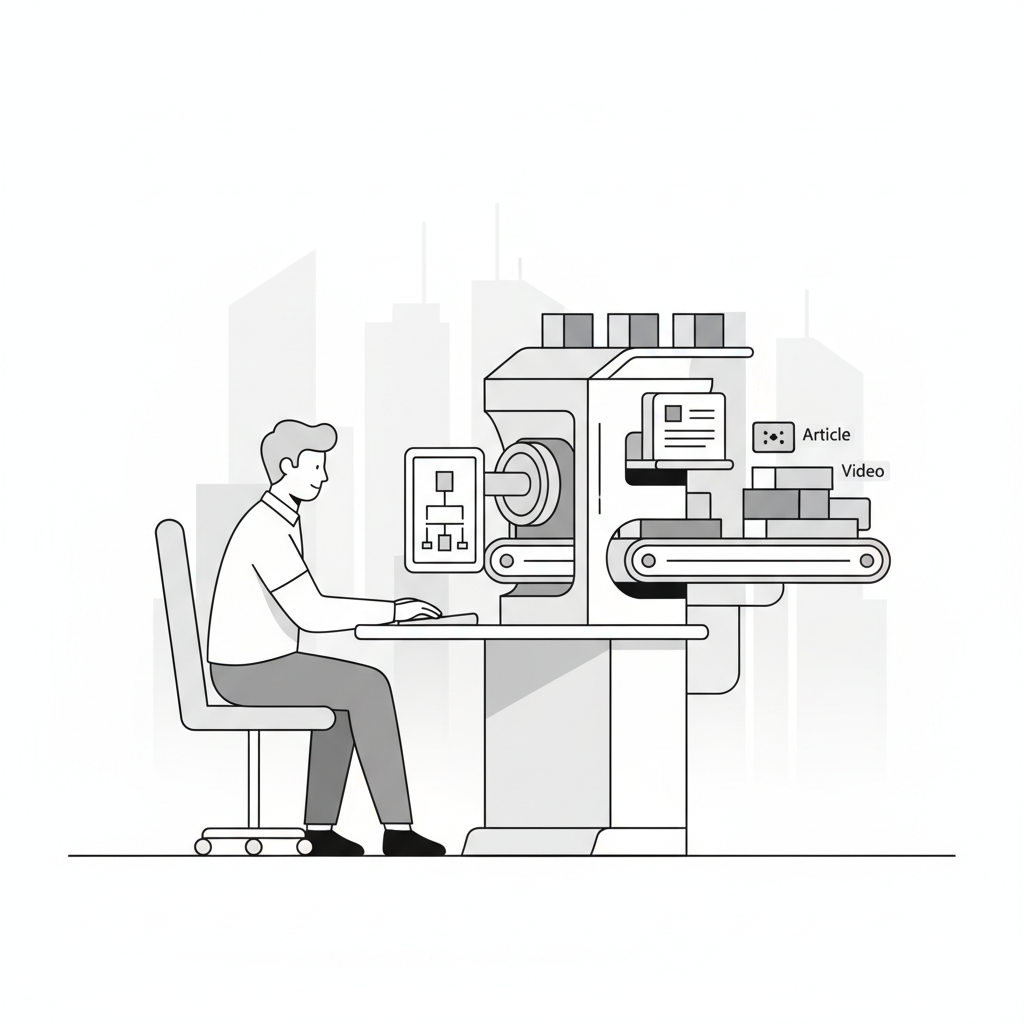
With a clear input goal, the next step is to build a system that executes it. Stop thinking about ‘writing an article’ and start thinking about running an assembly line with distinct stages: Ideation, Research, Outlining, Drafting, Editing, and Scheduling. Treat each piece of content like a widget moving through a factory. This emotional detachment is your greatest weapon against the silence.
My publishing machine runs on a simple project management board. Every idea is a card that moves through columns for each stage. I never sit down to a blank page. Instead, I might spend 30 minutes just finding data for three different article ideas (Research). The next day, I might spend 30 minutes outlining two of them (Outlining). This batching of similar tasks is incredibly efficient and removes the creative pressure. It transforms the work from a daunting art project into a series of small, manageable tasks. The process is the product. This approach aligns perfectly with creating the 5-minute daily habit that built my business because it breaks down a huge goal into tiny, daily actions.
The Power of Batching and Time-Blocking
I learned early on that context switching between coding, support, and marketing was killing my productivity. Now, my calendar is blocked out. Tuesday mornings are for ‘Research & Outlining.’ Thursday mornings are for ‘Drafting & Editing.’ This pre-scheduled focus time eliminates decision fatigue. I don’t wake up and wonder what I should do for my marketing; the system has already decided for me. This is a core principle: build a system that requires zero motivation to operate.
Step 3: Implement a System of Record (Your Single Source of Truth)
A calendar tells you what to do. A system of record proves you did it. This is a crucial distinction. The goal of this framework is to derive satisfaction from the process itself, and for that, you need a visual record of your completed work. It becomes your new scoreboard, replacing the empty analytics dashboard.
My system of record started as a simple spreadsheet. Column A: Publication Date. Column B: Title. Column C: URL. Column D: A ‘Published’ checkbox. That’s it. Every time I published, I added a new row and checked the box. Seeing that list grow was my new source of validation. It was tangible proof that I was upholding my end of the bargain, regardless of what the internet thought. This simple act of logging your inputs is a powerful psychological trick. It gamifies the process, making you want to ‘keep the streak alive.’
What My System of Record Looks Like Now
Today, I use the SoloFounderMarketing Toolkit, which integrates this concept directly. It not only tracks my published content but connects it back to the customer problems I was trying to solve, creating a strategic map of my efforts. But the tool isn’t the point—the principle is. Whether it’s a spreadsheet, a Notion database, or a dedicated platform, you need a single source of truth that celebrates the input, not the output. This becomes your private scoreboard, the one that actually matters in the early days. It’s a key part of fighting the urge to give up, a practical tool to get beyond motivation and beat procrastination.
How to Use the System to Reinforce the Habit
Place a link to your System of Record on your browser’s bookmark bar. Make it the first thing you open when you start your ‘marketing block.’ Before you begin the day’s work, look at the list of what you’ve already accomplished. This small ritual reminds you that you are building a body of work, brick by brick. It frames the day’s task not as a desperate plea for attention, but as the next logical step in a long and successful project.
Step 4: Schedule Public Accountability (Even to an Empty Room)
This step feels counterintuitive. If no one is listening, why announce your plans? The answer is simple: the announcement isn’t for them; it’s for you. This is a psychological forcing function known as a ‘pre-commitment.’ By stating your intention publicly—even if it’s just a tweet saying ‘New article coming next Tuesday!’—you create a small amount of positive social pressure that makes it harder to back down.
When I started, I would post my two-week publishing schedule at the beginning of each month on my personal Twitter account, which had maybe 10 followers. Did anyone care? Probably not. But I cared. I had made a public promise, and my desire to not look like someone who flakes out was a powerful motivator on days when I felt like doing anything but writing. This is a lesson I learned through many failures, and it’s a core part of my story of quiet consistency before any breakthrough. It closes the gap between intention and action.
The ‘Ulysses Pact’ for Content Creators
This technique is often called a ‘Ulysses Pact,’ named after the Greek hero who had his sailors tie him to the mast so he couldn’t steer the ship toward the deadly Sirens’ song. You are Ulysses. The desire to procrastinate or quit is the Sirens’ song. Your public announcement is the rope and mast. You are making a decision in the present that binds your future self to a wiser course of action. This is far more reliable than waiting for inspiration to strike.
Practical Application for Solo Founders
It doesn’t have to be a grand announcement. It can be a simple line in your email signature (‘P.S. Look for my new case study on the first of the month’). Or a recurring, scheduled social media post that announces the next piece of content. The medium is less important than the ritual. The goal is to create an external expectation that holds you accountable when your internal drive inevitably wanes.
Step 5: Conduct Scheduled, Detached Performance Reviews
If you’re ignoring likes and sales, how do you know if anything is working? You do it with scheduled, systematic, and emotionally detached reviews. The key is to review your process first and the performance second, and only at long intervals.
I committed to not looking at my Google Analytics for the first 90 days of implementing this framework. It was excruciating at first, then liberating. At the end of 90 days, my review wasn’t about ‘did I get signups?’ It was a checklist:
1. Input Adherence: Did I meet my goal of publishing 6 articles in 90 days? (Yes/No)
2. System Friction: Where did my publishing machine get stuck? (e.g., ‘I spent too much time finding images.’)
3. Time-Block Integrity: Did I consistently honor my scheduled marketing blocks? (Yes/No)
Only after answering those process questions did I allow myself to look at leading indicators—not lagging ones. Instead of sales (lagging), I looked at search impressions and click-through rates (leading). Is Google starting to notice my content, even if users aren’t converting yet? An increase in impressions from 10 to 1,000 is a massive win, even with zero clicks. It’s evidence your strategy is beginning to work. As Peter Drucker famously said, “What gets measured gets managed.” By measuring inputs and leading indicators, you manage the right things.
My 3-Month Review Checklist
My review has evolved. Now, every quarter, I analyze:
– Process Metrics: Adherence to schedule, friction points in workflow.
– Leading SEO Metrics: Total impressions, change in average keyword ranking, number of keywords ranking on pages 2-5.
– Leading Engagement Metrics: Not likes, but time on page and scroll depth. Are the few people who show up actually reading?
This data provides actionable feedback. If time on page is low, I need to improve my introductions. If impressions are flat, I need to work on my keyword strategy. It’s a calm, analytical process, completely removed from the emotional desperation for a sale.
Common Mistakes to Avoid With This Framework
Implementing this system isn’t complex, but there are common traps that revert you back to the validation-seeking mindset. I’ve fallen into every single one.
- Mistake 1: Peeking at the Stats. The most common failure mode is saying you’ll ignore vanity metrics and then checking your likes or sales ‘just for a second.’ This is like a dieter keeping a ‘secret’ stash of cookies. It undermines the entire psychological shift. Use a browser extension to block analytics sites if you have to. Be strict for the first 90 days.
- Mistake 2: Confusing ‘Process’ with ‘Productivity.’ This framework is not about churning out as much content as possible. It’s about consistently executing a sustainable process. If your process leads to burnout, it’s a bad process. The goal is a rhythm you can maintain for years, not a sprint you can hold for weeks. Remember, we are trying to build smart habits, not just hard ones.
- Mistake 3: Aiming for Perfection over ‘Published.’ The detached publishing machine is designed to produce ‘good enough’ content on a reliable schedule. Waiting for the ‘perfect’ article is a form of procrastination. Your system of record should reward you for publishing, not for creating a masterpiece. The market, in the long run, will tell you what’s a masterpiece anyway. Your job is to keep supplying it with candidates.
You’ll Know You’ve Succeeded When…
Success with this framework isn’t a sudden explosion of traffic or sales. It’s a much quieter, internal victory. You’ll know you’ve truly integrated this system when:
1. Hitting ‘Publish’ Feels Boring: You feel no major emotional spike after a post goes live. There’s no flush of anxiety or wave of hope. It feels like checking an item off a to-do list, like taking out the trash or responding to an email. The act itself is no longer emotionally charged.
2. Your Focus Shifts from Days to Quarters: You stop thinking about ‘How did today’s post do?’ and start thinking about ‘What topics will I be covering three months from now?’ Your strategic horizon expands significantly because you’re confident in the underlying system.
3. You Forget to Check Your Stats: You’ll go a week or more and suddenly realize you haven’t even thought about looking at your analytics. The need for that external validation has been replaced by the internal satisfaction of a process followed and a system that works.
When you reach this state, you have become antifragile. You are no longer dependent on the whims of algorithms or audiences. You have built a professional operation that can withstand the inevitable silent phases of a founder’s journey. This is the true foundation upon which all future growth—including the likes, comments, and sales—is built.
The most successful founders are not driven by flashes of motivation, but by a relentless commitment to a sustainable process.
Key Takeaways
- Stop chasing validation from likes and sales, which are unreliable lagging indicators.
- Define a controllable ‘sufficient input metric’ (e.g., publish 1 article/month) instead of an uncontrollable output goal.
- Build a ‘publishing machine,’ an assembly line for content (Ideate, Research, Draft, Edit, Schedule) to detach emotionally.
- Use a ‘System of Record’ (like a simple spreadsheet) to track your inputs, creating a new, internal scoreboard for validation.
- Implement ‘public accountability’ by announcing your schedule, even to a small audience, to create a forcing function.
- Conduct detached performance reviews quarterly, focusing on process adherence and leading indicators (like search impressions), not vanity metrics.
- Success is when publishing feels boring and your strategic focus shifts from daily stats to quarterly plans.
- The silent phase is not a sign of failure; it’s the necessary foundation for building a resilient, long-term business.
Frequently Asked Questions
How long does it really take to see results with this framework?
This is the most common and most dangerous question. The honest answer is: it will take longer than you want. In my experience, it took about 6 months before I saw the first ‘green shoots’ in search engine impressions, and closer to 9 months for a trickle of organic traffic. The key is to schedule your first review at 90 days and focus only on process and leading indicators (like impressions), not lagging outcomes (like traffic or sales). Expect a 6-12 month journey of quiet work.
What if I genuinely have zero ideas for content?
This is a symptom of not having a system for ‘Ideation,’ the first stage of the publishing machine. Your ideas shouldn’t come from inspiration. They should come from research. Spend one hour a week systematically reviewing customer support tickets, browsing forums like Reddit or Hacker News where your audience hangs out, and analyzing competitor content. Every question you find is a potential content idea. Log them in your System of Record. The SoloFounderMarketing Toolkit is specifically designed to uncover these ‘voice of customer’ diamonds from raw market data.
Is it ever okay to quit if absolutely nothing is happening?
Yes, but only after a systematic review, not an emotional reaction. If after 9-12 months of consistent execution your leading indicators are still completely flat (e.g., zero increase in search impressions, no change in keyword rankings), it might be a sign that your core strategy or topic area is wrong. The framework’s value is that it allows you to differentiate between ‘I quit because I was impatient’ and ‘I’m pivoting based on data that shows this approach isn’t viable.’ It’s a strategic decision, not a failure of will.
How do I stay consistent when I’m also building the product?
By choosing a ‘sufficient’ input metric that is almost laughably small. If you only have 2 hours a week for marketing, don’t commit to a weekly blog post. Commit to one 500-word post per month, or four thoughtful social media posts. The goal isn’t volume; it’s an unbroken chain of consistency. This is where building smart habits, not just hard ones, becomes essential. A small, consistent effort compounded over a year is far more powerful than a heroic, unsustainable burst of activity for one month.
Can this framework work for social media, not just blog posts?
Absolutely. The principles are universal. Your input metric might be ‘Post 3 quality threads on X (Twitter) per week.’ Your ‘Publishing Machine’ would have stages like ‘Idea > Research/Data > Draft Thread > Schedule.’ Your System of Record would be a simple tracker of the threads you’ve published. The key is to apply the same detached, process-oriented mindset and to ignore the vanity metrics of likes and retweets for at least 90 days, focusing only on whether you hit your input goal.
What’s the one thing to focus on if I only have 2 hours a week for marketing?
Focus on creating one single piece of ‘keystone’ content per month. A keystone is a well-researched, genuinely helpful piece of content that addresses a major pain point for your ideal customer. Spend your limited time making it as valuable as possible. Then, spend the next month’s limited time promoting that same piece. This is more effective than creating four low-quality pieces. Consistency doesn’t always mean high frequency; it means a reliable, repeatable rhythm.
Conclusion
A core tenet of long-term growth is shifting focus from short-term, emotionally-driven outcomes to long-term, process-driven outputs.
The painful truth of building something from nothing is that the world doesn’t care until it does. For a long, difficult period, your effort will feel pointless. The framework I’ve outlined isn’t about “motivation” or “hustle.” It’s a defensive system designed to protect your most valuable asset: your long-term consistency. It’s about changing the rules of the game so that you win simply by showing up and executing your process. You detach from outcomes you can’t control and anchor yourself to inputs you can.
Want proven systems to grow as a solo founder?
Learn more at SoloFounderMarketing.com — no fluff, no ads.